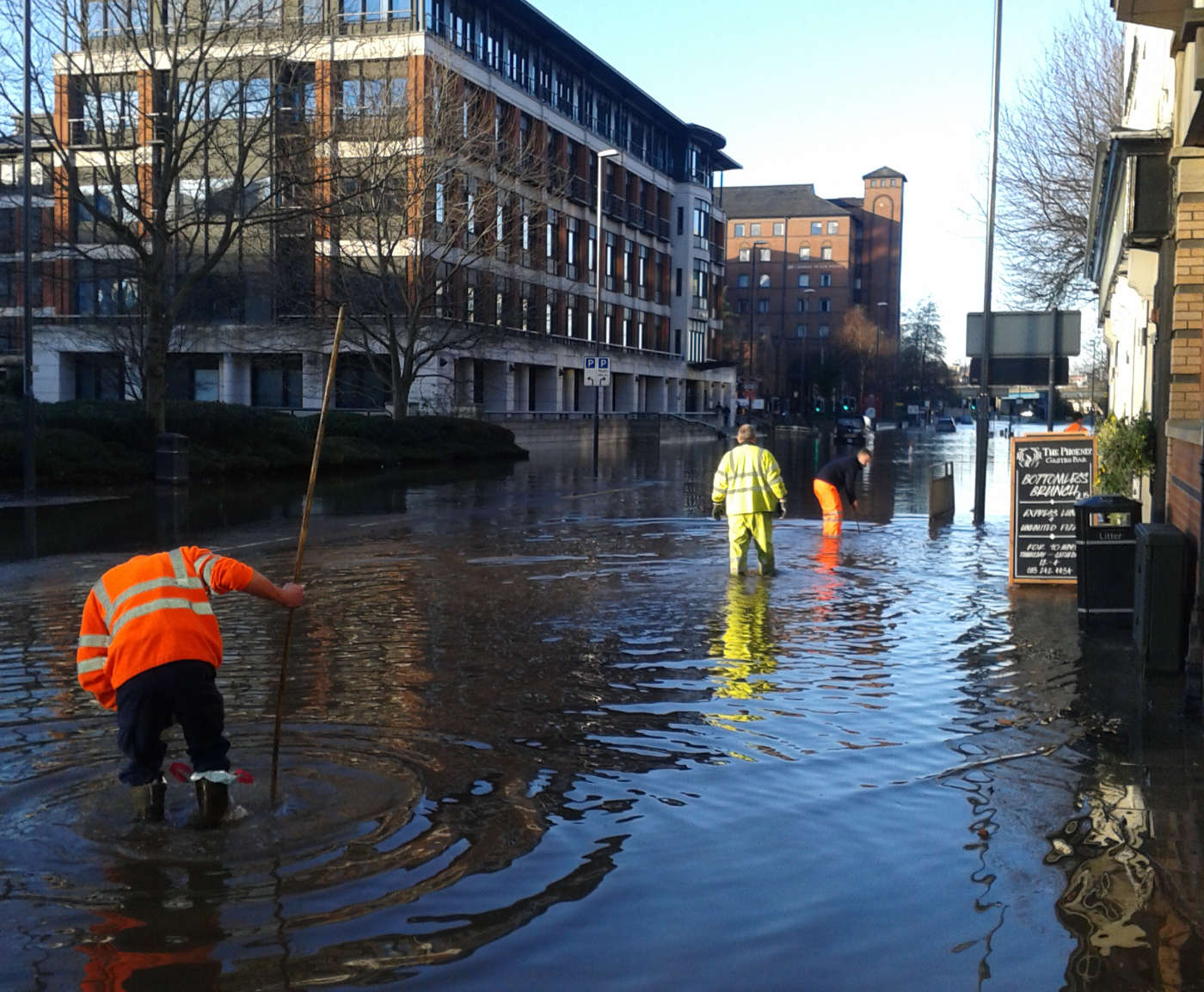
This year marks the tenth anniversary of the 2015 ‘Boxing Day floods’ in Leeds, when waterways across the city burst their banks in a 1-in-200-year flood event.
The floods, which directly impacted thousands of people and hundreds of businesses, would today be mitigated due to Leeds City Council and partners completing one of the largest flood alleviation schemes in the UK.
As people celebrated the festive season, Storm Eva caused the River Aire to reach its highest ever level of 5.2m following weeks of heavy rain. The river, which has a normal flow rate of 15 tonnes per second, saw an unprecedented 360 tonnes of water per second flowing through it. The storm conditions led to the three waterways in Leeds, the River Aire, the River Wharfe, and the Aire and Calder Navigation to become overwhelmed.
The resulting flood waters affected fourteen Leeds wards and caused devastating damage to over 2600 homes, 650 businesses, and impacted key infrastructure such as power substations, communications systems, and parts of the road and rail network.
In monetary terms, it is estimated that the floods cost Leeds £36.8m in direct costs and the wider region over £500m to clean up. However, the impact on the physical and mental health of residents and business owners was incalculable.
After the flood waters receded, work immediately began on assessing the damage and reopening infrastructure. Over 1000 volunteers helped with the clean-up, reflecting the community spirit in affected areas across the city.
Ten years on from these devastating events, flood resilience in Leeds has never been stronger, following the completion of the Leeds Flood Alleviation Scheme, along with several smaller projects across the city.
Working with partners including the Environment Agency and West Yorkshire Combined Authority (WYCA), Leeds City Council has directly completed a £200m project to protect 4000 homes, 1000 businesses, and safeguard 33,000 jobs across the city to a 1-in-200-year standard of protection.
The first phase of the Leeds Flood Alleviation Scheme, known as FAS 1, was completed in 2017.
Protecting the city centre, FAS 1 stretches from Leeds Station to Woodlesford. The works involved merging the River Aire and canal at Knostrop Cut, building a range of new walls and embankments that still allow waterfront access, and using two innovative movable weirs at Knostrop and Crown Point, that can be lowered independently to temporarily create more space in the channel. The weir technology used is the first of its kind deployed in the UK.
The second phase of the scheme, known as FAS 2, was completed in 2024 and runs from Leeds Station to Apperley Bridge in Bradford.
Phase two saw the introduction of several miles of linear flood defences, the introduction of several new pumping stations and flow control structures, and the construction of a huge flood storage area near Calverley. The new storage area, which is operated through raising two large flood gates, has an embankment of 200m in length and a height of 6.2m, meaning it can store the equivalent of over 720 Olympic-sized swimming pools’ worth of water when needed, which can be slowly released once the danger has passed. In addition to the flood alleviation infrastructure, a team of Leeds City Council flood experts and engineers are on standby around the clock, 365 days a year, to operate and maintain the flood defences.
The Leader of Leeds City Council, Councillor James Lewis, said: “The Boxing Day floods of 2015 directly impacted thousands of people and hundreds of businesses across the city, causing untold misery and impacting people’s health, wellbeing, livelihoods, and property.
“Ten years on from that dreadful day, we can take pride in the decade of dedication, partnership working and teamwork that has delivered some of the UK’s most robust flood defence infrastructure to mitigate the threat of a repeat flooding event.
“Earlier this year, Leeds launched its refreshed Leeds Ambitions, which aims to create a city that is healthy, growing, thriving and resilient. The work to increase our flood resilience impacts all these goals.
“We know that if Leeds FAS operates to its full potential just once, it will have saved more carbon cost than used to build the entire infrastructure.
“The new flood defences also help to grow our city’s economy, ensuring that businesses and infrastructure are better protected from flooding, and once flood-prone land is made available for development, while also protecting our environment and greenspaces, our community centres and sports facilities to ensure that communities can thrive.
“But most importantly, our work over the past decade has helped protect our residents from the harm, both physical and mental, that flooding can bring.
“In 2015, my predecessor as Leader, Baroness Blake, said, ‘a preventable disaster like this must never happen again’. While we can never fully eradicate the threat of flooding from rivers or caused by surface water run-off, we can be very proud of the steps we have taken over the past decade to protect our beautiful city, its businesses, and its people as we move forward into an uncertain future for our climate.”
A wider programme of smaller flood alleviation projects has also been completed around the Leeds district including schemes in Garforth, Wyke Beck, Mickletown Pit Lane, Otley and Sheepscar. Several more are planned, including works at Meanwood Beck, Thorner Beck, Millshaw Beck, and Wortley Beck.
Above: The new embankment near to the River Wharfe in Otley, which forms a part of the Otley Flood Alleviation Scheme. Below: The River Aire in Malham. (Pictures: Leeds City Council)
Tracy Brabin, Mayor of West Yorkshire, said: “Ten years on, we remember the devastation faced by communities across West Yorkshire, and the remarkable strength shown in the aftermath of the Boxing Day floods.
“We’re determined to reduce the risk of this happening again, so together we are investing to boost our defences.
“This will ensure West Yorkshire is better prepared for generations to come.”
Alongside the infrastructure and engineering works within Leeds, a new organisation called the Aire Resilience Company, an innovative community interest company (CIC), has been set up to create a sustainable business model to install and maintain one of the largest natural flood management schemes in the country, complementary to the hard infrastructure measures.
Through a consortium of Leeds businesses, funding has been sought to plant up to 750,000 trees and 1240ha of land management in the upper River Aire catchment area, to slow the flow of water from the source of the river and maintain the standard of protection of the Leeds FAS against climate change into the future.