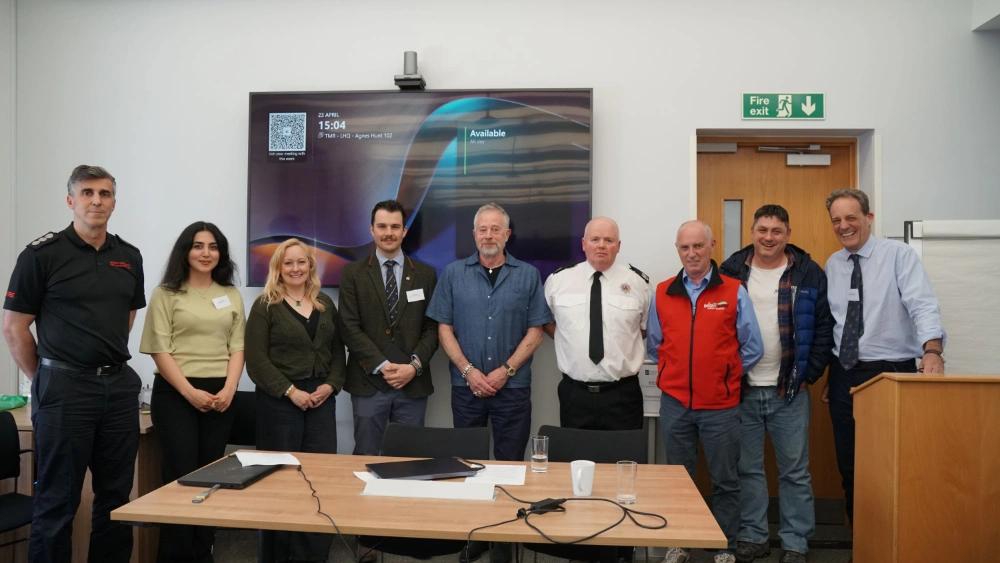
A new cross-border commission has been launched by the UK’s Regional Moorland Groups to establish what effective, practical wildfire fuel load management looks like across the country’s upland landscapes – and, crucially, how it can be delivered at scale.
The Wildfire Commission held its inaugural meeting in London yesterday (April 23), bringing together land managers, fire and rescue services, and leading academics. The commissioning programme will focus on one of the most critical – and controllable – elements of wildfire behaviour: fuel load.
Set against a backdrop of increasingly severe wildfire incidents, including the devastating Carrbridge and Dava Moor wildfire at Strathspey in Scotland last year, the Commission aims to move beyond theory and process, and towards a shared, operational understanding of how fuel can be managed to reduce risk, improve containment and protect communities.
The commission’s first meeting also coincided with the UK Parliament’s EFRA Committee launching a call for evidence on the growing threat posed by wildfires in the UK. The National Fire Chiefs Council said that 2025 broke UK records for the most reported incidents of wildfires, surpassing the previous record in 2022.
At its core, the initiative will examine how fuel loads are measured, distributed and managed across moorland landscapes – and how this knowledge can be translated into practical, regionally tailored fuel load management plans that are genuinely useful to fire and rescue services.
Mark Ewart, National Engagement Manager for Scotland’s Regional Moorland Groups, said:
Wildfire is no longer a distant or occasional threat – it is a growing and very real challenge for rural communities, emergency services and the landscapes we all rely on.
This commission is about cutting through the noise and focusing on what actually makes a difference on the ground. We know that weather and topography will always play their part, but fuel load is the factor we can influence. If we are serious about improving resilience and protecting lives, it has to sit at the heart of how we plan for wildfire.
What we are setting out to do is practical and outcome-focused – to define what good fuel management looks like, and how it can be delivered consistently and credibly at scale across the UK.
Richard Bailey, Coordinator of the Peak District Moorland Group, said:
The Wildfire Commission has been a welcome catalyst for further regional workshops and engagement around the importance of fuel load management. Crucially this shouldn’t just be about more round table discussions and consultations, but a mechanism leading to real, tangible actions on the ground that are pivotal in the reduction of the extent and impact of wildfires, which many consider is long overdue.
Well done to the UK’s Regional Moorland Groups in bringing together this wide collective of practitioner expertise, professional fire service personnel, leading academics in fire behaviour and those with a genuine concern in the direction of travel of wildfire impact on our upland habitats and communities.
The insight given by practitioners from their extensive experience and understanding around fire behaviour, whilst also coupling that with modern day science and mapping techniques from recognised academics can only lead to a direction of travel leading to a reduction of damage caused by the increasing risk of wildfires in the uplands.
In the coming months, a series of regional workshops are planned, designed to bring together local expertise and produce workable, evidence-based approaches tailored to different moorland environments.
Organisers say the ultimate goal is to shift the national conversation from abstract frameworks to delivery – ensuring that future wildfire planning is underpinned by practical, coordinated and evidence-informed fuel management. If successful, the commission is expected to lay the groundwork for a more joined-up and effective approach to wildfire resilience across the UK’s uplands, helping to better protect landscapes, communities and those on the frontline of wildfire response.
The Carrbridge and Dava wildfire in 2025 is believed to be Scotland’s worst wildfire ever. According to a report by Scottish Land & Estates, 11,827 hectares of moorland and woodland were devastated by the fire. More than 100 people from 33 rural businesses, including 27 estates, tackled the fires alongside the Scottish Fire & Rescue Service. At least 110 ATVs, fogging units, tractors, diggers, water bowsers and other assets were deployed.
The collective value of specialist firefighting equipment deployed by land managers is conservatively estimated at £4million.
Iona McGregor, Regional Coordinator for the Angus Glens and Grampian Moorland Groups, said:
The scale and intensity of the Carrbridge and Dava fire brought into sharp focus just how challenging wildfire can be when fuel conditions are not properly understood or managed.
From a practical land management perspective, there is a clear need for a more consistent and shared understanding of how fuel behaves across different landscapes, and what can realistically be done to reduce risk before a fire starts.
This commission is an important step forward because it is grounded in real-world experience. It is about bringing together those who manage the land, those who respond to fires, and those who study them – and making sure that knowledge translates into practical action on the ground.
The UK Moorland Groups involved in the Wildfire Commission are:
Angus Glens Moorland Group
Calderdale Moorland Group
Forest of Bowland Moorland Group
Grampian Moorland Group
Loch Ness Rural Communities
Nidderdale Moorland Group
North Yorkshire Moors Moorland Group
Northern Pennines Moorland Group
Peak District Moorland Group
Southern Uplands Moorland Group
Tayside & Central Scotland Moorland Group
Yorkshire Dales Moorland Group